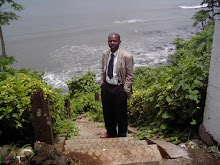
The Committee to Protect Journalists is outraged by today’s death of newspaper editor Germain S. Ngota Ngota, whose health deteriorated while he was incarcerated in Cameroon. The death certificate for Ngota, editor of the private bimonthly Cameroon Express, determined that the journalist died from a lack of medical attention in Kondengui prison in the capital, Yaoundé, according to editors Hilaire Medjo of the weekly Nouvelle Vision and François Fogno Fotso of the weekly Génération Libre.
Ngota was one of three journalists imprisoned since February because they were investigating corruption allegations involving top presidential aide Laurent Esso and the state-run oil company SNH. Authorities have not addressed claims by reporter Simon Hervé Nko’o of the weekly Bebela that security agents used psychological and physical torture to force the journalists—including Ngota—to reveal their source for a document on which the allegations were based.
Ngota was detained in the Kosovo ward of Kondengui prison, where hard-core felons are held, according to local journalists. Friends and colleagues who visited the journalist in prison on Sunday told CPJ that he had complained of fatigue, gout, and joint pain. Ngota also suffered from high blood pCameroonian officials notified Ngota’s family of his death but had not publicly commented by late today. Assistants at the communications department of the Cameroonian presidency told CPJ no officials were available for comment. An assistant to Cameroon Communications Minister Issa Tchiroma Bakary told CPJ the minister would only respond to a written request for comment, which CPJ sent today.
“The authorities failed to provide Ngota with adequate medical treatment despite repeated requests by his family and colleagues,” said CPJ Africa Program Coordinator Tom Rhodes. “We hold them responsible for his death and the well-being of the three other journalists still held in Cameroonian prisons.”
Newspaper editor Nestor Nga Etoga, who knew Ngota since 1995, described the late journalist as “talented” and well-known locally for his investigations on public corruption in the oil sector. According to Fotso, Ngota launched Cameroon Express in 2002-2003 and freelanced for several other publications. He was a 15-year veteran of the Cameroon press.
Ngota, 38, was the first Cameroonian journalist to lose his life in relation to his work, according to CPJ research, which goes back to 1992. He is survived by a wife and two children.
Friday, April 23, 2010
Jailed journalist dies in Cameroon prison


Wednesday, March 24, 2010
Of Jihads and Jeremiads: Vain Struggles in the Name of God
 Nigeria singles out itself as the most violent soldier for Allah and Christ. Most northern Nigerian towns are flashpoints of intractable conflicts and feuding in the name of a god most people perceive through individual bias prisms. Over the past weeks, hundreds of Nigerians from across the religious spectrum have lost their lives in a struggle to affirm the superiority of one belief form over the other.
The Muslims declare a Jihad against the infidel Christians, while the Christians embark on Jeremiads against the savage Muslims. The ‘Realm of Peace’, where the Muslims call their favoured place is considered violated when pockets of peoples believing in something else exist; hence a ‘Realm of War’ prevails. Because of the cohabitation of Muslims and Christians in Northern Nigeria it is doomed to be in tension.
This permanent cultural/religious strife is not common to Nigeria alone. By way of comparison, we could cite the Crusades, European colonization of the New World, America’s sense of ‘Manifest Destiny’ (ordained by God as world leader), or the religio-political dualism of the Achaemenian kings. Away from their bona fide differences, all these historic projects are fuelled by sharp twofold distinctions between ‘us’ and ‘them’, in alliance with other bigoted contrasts, including moral versus immoral, modern versus primitive, dominant versus submissive, eugenic versus dysgenic, and sacred versus profane,. Those using such discourse naturally see themselves as persons who comprehend and strive to realize God’s will, that is maintaining a cosmic order or at least to impose that order they define as rational and progressive; while characterizing their rivals as religiously ignorant or rebellious.
Of the Holy God we seek his favor and succor, we all have to climb up the Jacob’s ladder, for in the eyes of God we are the lost tribes who have to strive to find his face. As to some people having the roadmap to God and holding the key to his kingdom, it remains to be seen through which valid model they qualify themselves.
The other day, the ‘erratic’ Colonel Khadafy proposed the partition of Nigeria along religious lines; Muslims in the North and Christians in the South. The distribution of religion in Africa did not happen along the same lines that the partition of Africa as the 1884 Berlin Conference, where a line was drawn on a paper and the east went to France and west to England. A complex series of Jihads and conversions to Islam took place just as the conversion to Christianity was going on. In the same ethnic group in Africa it is easy to meet dozens of different denominations/ religions. In the particular case of Nigeria, in the south, the Yoruba are both Muslims and Christians and in the North there are also pockets of Christians. Neighbouring countries like Cameroon have succeeded in interfaith campaigns where ecumenism is celebrated at the highest national level with the peaceful coexistence of cathedrals and mosques.
I have been wondering when Mohammed and Christ transferred their cross to Africans. It is understandable when Palestinians and Israelites fight. Fundamentally, the struggle is not over faith but over land. There are Muslims as citizens of Israel while there are also Christians as citizens of Palestine. The war over occupied territories is neither for Christ nor for Mohammed but for territory. When Khadafy compares his solution for Nigeria to the separation of Pakistan and India, he forgets the complexities of that region. We may again draw from the religious conflict pitting the Catholics and Protestants of Northern Ireland. Sheer fanaticism is giving way to wisdom in Ireland, inspired by the South African post-apartheid Truth and Reconciliation Committee. It is easy to comprehend the struggle between the races but that between religions, coming in the realm of faith is better surrendered to the God in whose name we feud.
On the racial score, Charles Darwin might be recorded as the father of racism with his elaboration of his Evolution of Species. Continuing the bias of Herodotus, the father of history, against the black race, Darwin’s study was inspired by his quest to find a blueprint for the survival of the white race. In his work “the Evolution of Species…” he creates a coded formula for the survival of the Caucasian (white). Notice the truncation of the title of Darwin’s study. The complete title is “The Evolution of Species and the Survival of the Favored Race,” the favored race here meaning the white race. Most experiments carried under different code names are only geared to controlling the other races and promoting the survival of the white race. Eugenics, apartheid, Nazism, was all for the preservation of one race, the white race.
By the time Africans fight along other races which want our annihilation, we sign our own death pact. Africa was enslaved, colonized and dehumanized in all sorts of ways, by all other races. Today, Arab Muslims kill black Darfurians in Sudan; Africans are seen as the greatest threat to the survival of the white race. Obama’s election as the 44th president of the United States gives enough justification for the racist movements to convince the doubting that the black man is about to take over the world. How do we then preserve our race when we join in vain struggles?
Africa had no reason to be involved in the First and Second World Wars. But we fought and died in King George’s Army, the Reich and the French armies. Biological weapons are all designed as subtle means to curb African population. When Africa numbered a billion people, the rest of the world cried foul. ‘Oh, how is Africa going to feed its billion people?’ But Africa has enough fertile lands, tenfold more than Europe. As to where the poor Africa was going to find the means to develop itself, Africa has the most wealth, the whole world put together.
Africa just needs to define itself, name itself and understand the minds of the other races who have taken enough time to understand the African mind. When Africa understands that it is a threat to the rest of the world, it will learn to develop means to counter the actions of the Economic Hit Men. Economic Hit Men was a cream of economists, scientists, engineers, professors trained to take over the developing world in subtle means in order to exploit their natural resources for the advancement of the interests of the industrialized world. The Economic Hit Men either succeeded in their ensnarement of developing countries, or they assassinated their patriotic leaders who stood in their way. When they failed to assassinate, they provoked a war and then came in and reaped the booty. While Africa loses its sons and daughters to the Economic Hit Men, it cannot afford to lose more in the name of God.
Sunday, March 21, 2010
Buea Coffin Riders
 Every Friday, a horde of young folks troupe into Buea from adjoining villages on buses and on noisy motorcycles (bendskin). Their mission to Buea is for the weekly business of coffining a deceased friend or relative at the Buea Regional Hospital Annex mortuary. Weekends are generally favoured as they provide three days in a stretch to mourners. These mourners come into town riding on coffins.
Death has become a banal enterprise in Cameroon, as you would easily meet a two year old discussing dying excitedly and knowledgeably, things we of the days of yore dreaded even thinking about. People die for all sorts of reasons, motorcycle accidents, HIV/AIDS, stress and hypertension, suicide and all. The morose economic environment and the inability for most families to get their worth from life push them to the brink of nihilism and self rejection.
Brisk business is going on in Cameroon as undertakers thrive in providing services ranging from supplying coffins, providing hearses, funeral guards, hiring mortuaries, and entertaining and refreshing mourners after burial. Mourners and relatives of the deceased look for all means to excel by providing the best coffin and most grandiose funeral. According to Mola Ikome, “After Pa Kinge had worked so hard during his life, he should be given a befitting burial.”
Befitting burial is what Camerounese authorities are looking forward to giving the Pan-Africanist, Ndeh Winston Ntumazah on 27 March 2010. One needs to be in Bamenda on that day to judge the hypocrisy of many when it comes to funerals. For most people riding coffins noisily, beyond the show and sheer karma building, there is no meaning they attach to the momentary outpourings on funeral grounds. After abandoning someone in life, in sickness, what do we want to tell them with the outpouring of grief and the unreserved expenditure for coffins to catch the eyes of the ‘dead but living’?
Some of these coffins, made out of glass, aluminum and hardwood will cost the upwards of FCFA 150,000. Somebody just whispered to me that this amount will get only the cheapest coffin made out of stained white wood. Some folks do not hesitate getting coffins in the neighbourhood of millions, all in the name of a decent burial. Some mourners will be heard commenting that the coffin was the most beautiful and expensive. The dead hardly feel any difference in a coffin and what will a coffin of gold mean to Ndeh Ntumazah who had died since 2006 (when he became senile and could be heard asking what Nkraumah was doing), spiritually. In fact, before some people die physically, they would have already died long in advance, as their conversation will be about the dead than living.
It looks like most of us are long dead and we are only dead but living masses moving around and causing havoc to God’s people. Why do we have so many heartless people with dead consciences all over the place? They are dead but living. We are also dead but living when we invest only in the dead. Building mortuaries everywhere and allowing the dead to remain in the mortuary for more than 2 days is some form of desecration. Except for legal reasons, the dead should be allowed to continue their journey to the earth, dust and ash from which they came. Any delay is a travesty against their human right to prompt and decent burial. Some folks claim building mortuaries in their villages is development. This is only development of death and elevating it to an industry.
This raining season, hundreds of families have been dispossessed of their planting seeds by the serious hunger from the last two years. That is the death to be given a decent burial, poverty and hunger. Many will not be able to plant the fields because they do not have the seed s to plant. Next door to them tens of millions will be buried along some state personalities in the guise of state burials. The huge amounts used could be invested in farm seeds for poor farmers. That will be a development project not mortuaries and coffins.
Back to our Buea Coffin Riders (BCR), who have no other form of entertainment and showing off. They come in from small agglomerations like Ekata, Muyenge, Mamou, Ekona and Muyuka. Those places have no mortuaries. The BCRs usually accompany friends they called super bendskin riders, who unfortunately were killed riding. You need to see the way the bendskin speed on those roads to conclude that people die the way they live. Even when they die they give further reasons for people to dread and wish they were banned.
They put up macabre spectacles, with loose exhausts as they speed up and down the lone Buea Street with 4 to 5 passengers a bike. They accelerate like a space shuttle rocketing to its doom. While the escort speeds up and down a lone bus will carry other mourners and a coffin on the carriage. On the coffin, five young men will be sitting chanting loudly and waving leaves.
I tried finding out from Tebah why all the ambiance and wildness. “We have to sendoff our comrade in pump and noise. You know we bendskin are a lively and courageous bunch. We die once and die in noise. When we do not die we are maimed forever. It is better dying in active service and being sendoff professionally. Tebah said.
What a fatalistic conclusion. The karma of the occupant of the coffin is even made heavier by the five riders sitting over it. Every Friday, and sometimes Thursdays when I return to my mountain hut in Buea, I try to find answers to the uselessness of life in Cameroon as exemplified by the BCRs. Some of them even have to come to the mortuary on weekdays because the mortuary is so full and they have to create space for new bodies to be admitted. If dying does not mean a thing to anybody, then you may easily understand the attitude of the politicians who do not care about the plight of the common man. Week in week out, the coffins will be rode out of Buea with death a permanent visitor in town. Man has to conquer death by ignoring it and not celebrate it. When you ignore death, it dies from neglect.
By Christopher Fon Achobang
Thursday, March 11, 2010
Mamadou Tandja And Virtuous Cycles Of Niger's Democracy

Two cycles of political struggle exist in Niger today: that with Hamani Diori, Mohamane Ousmane, and Mamadou Tandja as the linking beads; the other with Seyni Kountché, Ali Saibou, Ibrahim Baré Mainassara, Daouda Malam Wanke, and Salou Djibo as the links. One is a constellation of "democratically elected" civilians; the other is made up of people we would refer to here in Cameroon as "les grands muets" [those that never speak] - soldiers!
Both cycles are intertwined, and work on the understanding that any historical continuum can be broken; that new beginnings are always possible. In other words, the beads on one chain alternate (regularly) with the beads on the other... These cycles have been interspersed by "the people" organising general strikes, sit-ins, civil disobedience and protest marches to fight for their sovereignty.
The people have been fighting to have their say in the changing process. Going by Lenin's rhetoric that the proletarian army is first recruited in the struggle, and Rosa Luxemburg's that the masses must learn to use power by using power, it can be said that in the process, the people have been learning how to use their power; they have been struggling to institute democracy in Niger.
Therefore, unlike in countries such as Cameroon where a vacuum was created by an anti-colonial war that ended in the defeat of nationalist forces, and the ensuing one-party rule with its sit-tight leaders, the intertwined cycles in Niger are generating a consciousness and an activism that is slowly expanding the domain of freedom, at the detriment of power.
True, the rule is that in republican government, the military is subordinated to civil power; the principle of absolute civilian control over the military is universally accepted. But such subordination should only be valid where the civil power is a derivative of the people's will, "expressed in periodic and genuine elections which shall be by universal and equal suffrage and shall be held by secret vote or by equivalent free voting procedures", as required by the universal declaration of human rights.
Unfortunately, in most African countries, the people are held hostage by a cabal that passes for the civil power. Further, in most democracies, soldiers finish off as congressmen, bank presidents, senators, manufacturers, judges, governors, diplomats and democratically elected presidents. Indeed, several of the 44 presidents of the US have been former soldiers.
Although none of the cycles in Niger has any single, concrete result that could mark its success, the unintended benefit to the people is laudable, barring the duplicity of the so-called international community that claims to prefer the civilian cycle; and the penchant of African organisations, dominated by sit-tight civilian leaders, to disrupt any attempt by soldiers to rock the tranquility of their exclusive club...
As the beads on the intertwined cycles in Niger change places, we continue to ponder the fate of democracy in our countries. Indeed, elections that are supposed to be the hallmark of democracy, mean one thing in the West, and completely another in African countries. In our Cameroon, they have come to represent a process through which the powerful give their stay in power a semblance of legitimacy, since they know that their "victories" do not derive from the people.
Invariably, following the fraud to render the consent of the people irrelevant, there are always condemnations, reports of international observers, the cutting of aid, and sometimes relations, all of which, sooner or later, convert the "winners-by-fraud" to "democratically elected" leaders! Then friendship is quickly re-established through juicy exploration, mining or other commercial bargains... Locked in their "new" friendship, they make similar noises about fighting "poverty", the greatest scorch of the same people the friendship made powerless.
It is always well known that those who win leadership through fraudulent elections do not have their people behind them.
It is also a well known fact in international relations that it is easier to deal with a leader that does not have his people behind him, than with one that has. This is why to Wangari Maathai's question why Africa is one of the richest continents on the planet, endowed with oil, precious stones, forests, water, wildlife, soil, land, agricultural products, and millions of women and men, and yet most of Africa's people remain impoverished, I can say here that it is because their illegitimate leaders cut bad deals to gain friendships that comfort their eternal, fraudulent stay in power.
The generation of the 60s that succeeded the White man in Africa following independence failed to use the momentum of the struggle for independence to completely free the continent from the dominance and influence of the West. The intertwined cycles in Niger, and the struggle they are inducing in the people, are creating a shared experience, a common sense that is preparing them for Niger's own revolution. After all, revolutions to create new beginnings of liberty and freedom are good for every people, in every society, including here in Africa. Let Niger's struggle continue
Wednesday, March 3, 2010
Of Terrorism and Patriotism: Tribute to Ndeh Ntumazah, Nelson Mandela, et al.

 Ndeh Ntumazah, Cameroon’s long serving “maquisard” or terrorist for 60 years was ‘rehabilitated’ in a presidential decree signed by President Paul Biya of the neo-colonialist République du Cameroun granting him a State Burial. This crusader for the union of the populations of Cameroon , who never benefited from the Cameroonian state except negative categorization, will posthumously be raised to the status of Patriot Number One, as such erasing the fairytale images of a dangerous terrorist.
Last year, Madiba Nelson Mandela, South Africa ’s first majority president, branded terrorist for over 40 years saw his name removed from the list of terrorists, and given a special day in the history of the community of nations by elevating his birthday to a United Nations Day. Few former terrorists in their lives have been so lucky to be rehabilitated and celebrated. Needless reminding ourselves that Ndeh Ntumazah, Ernest Ouadie, Um Nyobe, Wambo Le Courant, Patrice Lumumba et al, all fought for the liberation of their people from an oppressive neocolonial dispensation.
Even at the end of colonialism, the departing colonials made sure they installed neo-colonials to continue their plunder of Africa . Under such pseudo-nationalists the true sons (patriots) of Africa , who fought for the survival of the continent were hunted and assassinated like mad dogs. Africa lost hundreds of its most valuable sons in such circumstances, in what Jean Ziegler terms the depersonalization of a people. Indeed, most Africans allowed themselves to be used in very inhuman ways and some of their brothers worked and continue to work as accomplices of the colonialists.
For all their perceived crimes against the peace of the people, John Stuart Mill, in On Liberty published in 1859, states, “No argument, we may suppose, can now be needed against permitting a legislature or an executive, not identified in interest with the people, to prescribe opinions to them and determine what doctrines or what arguments they shall be allowed to hear.” This is in tandem with the redefinition of our history and aspirations.
Neither the French nor Ahidjo had any reasons to stop the members of the UPC (Union of Cameroonian Populations) from arguing that it was best to reunite all the populations in the former German Kamerun. Ndeh Ntumazah and his associates were all justified in their wishes and history has proven them right in this anniversary year of Cameroon ’s independence. The Unity of Cameroon is celebrated today, in total forgetfulness of those who fought for it. When Yaounde cited people to be honoured for the independence of Cameroon , valuable patriots like Ndeh Ntumazah, Um Nyobe were not considered. Yet without the pressure and guerrilla tactics they used, Cameroon ’s quasi-independence will still be undergoing negotiation, today.
If Margaret Thatcher has been reduced to obscurity, it is not because she is lackluster or sick but because she is haunted by her actions of despising Nelson Mandela. On an official trip to South Africa , an impetuous reporter asked her whether she would visit Nelson Mandela in Robin Island . Margaret Thatcher replied that “The prime Minister of England does not talk to terrorist.” A few months after, Mandela was freed from prison and became the first South African majority President. As president, Margaret Thatcher sought an audience with him. In typical Mandela outspokenness, he replied, “Terrorists don’t receive the Prime Ministers of England.” Poor Margaret Thatcher has never recovered from this shock.
It is quite a marvel how some celebrated terrorists metamorphose into venerated patriots. I am forced to go into the nuances of who is a terrorist and who is a patriot. A patriot is a person who loves his country and defends and promotes its interests. He is also one who remains loyal to his country when it is occupied by an enemy. A terrorist is an advocate of terror as a means of coercion. Ndeh Ntumazah, Nelson Mandela et al were all people who loved their countries passionately and were ready to defend and promote their interests. For Ndeh Ntumazah he understood that the formidable French colonial regime could only be defeated if the populations of Cameroon united to chase them out. This was frightful to the French above everything else. It provoked terror as they were frightened imagining the eventuality of losing all the wealth in Cameroon . But for pa Ndeh and his friends they were simply defending their beloved countries.
The wonder is why it took so long for their compatriots to recognize that they meant all good for their country. Pa Ndeh died on 21 January 2010 in St Thomas Hospital , London , destitute, senile and demented. No Cameroonian authority paid him a single visit or provided the basics for this historic patriot to survive. Ndeh Ntumazah was not so lucky like Nelson Mandela to see larger than life-size statues erected in his honour.
As Ndeh Ntumazah will be flown back to Cameroon for a State burial on 27 March 2010, his persecutor Ahmadou Ahidjo will be turning in his grave in Senegal . The irony is that since his death in 1988, Ahidjo remains a fugitive on the run from the country he prevented Ndeh, Ouandie, and Wambo from having a quiet enjoyment in.
Today, of the many lessons we learn, we will learn not to be conformers to common place. It is not because everybody is condemning an idea or a movement that it becomes trendy. Timeservers for truth will remember Socrates was put to death, but the Socratic Philosophy rose like the sun in heaven and spread its illumination over the whole intellectual firmament.
In University environments expected to be intellectual laboratories, the same political intolerance that characterizes the mundane world is manifest. Dissentients afflicted by the malady of thought, prescribe a convenient plan for having peace in the intellectual world, and keeping all things going on therein very much as they do already (undisturbed by vigorous debating). But the price paid for this sort of intellectual pacification is the sacrifice of the entire moral courage of the human mind. Professor Nyamjoh and others were chased out of the University of Buea for simply passionately believing that there was an Anglophone problem. Today, I join the chorus of the blacklisted and hunted for truly believing there was a problem in Cameroon and the University of Buea , where impostors and pseudo-intellectual s brand patriots as terrorists.
I have been articulating this Anglophone problem since 1990, to the surprise of people like the veteran political anarchist Sam Nuvala Fonkem. He is surprised that I was never witness of the Southern Cameroons period, yet I am able to command the courage to articulate its concerns. For this vituperative approach to the Southern Cameroons problem, some faculty at the University of Buea elected to brand me terrorist, while those who have sold their souls to the occupiers are hailed as patriots. Yet, today’s patriots will be portrayed and spared from the hang post tomorrow only by humanitarian considerations.
May the rehabilitation of the patriots falsely branded terrorists begin on 27 March 2010 with the honours due a real patriot like Ndeh Ntumazah. I am not waiting for a posthumous honour because people like Ateba, Tiayon Boromee et al have said I am a threat to the lethargic minds of moribund intellectuals. We, today’s blacklisted terrorists, tombstone for the destroyers of our patrimony, simply want to be given the opportunity to fight and defend the interests of our beloved country and people.
Thursday, February 18, 2010
Cameroon: Government Forces continue to Incarcerate Journalists
 Security agents in the Republic of Cameroon, a country noted for torture, and human rights violation have detained two journalists, in an apparent effort to learn the source of a purported memo from the chairman of the state oil company about the purchase of a luxury boat, according to local journalists and news reports.
Agents of Cameroon's Directorate-General of External Intelligence (known by its French acronym DGRE) took reporter Simon Hervé Nko'o, of the weekly Bebela into custody after searching his home, according to news reports. Another journalist, Serge Sabouang, editor of the bimonthly La Nation, has also been held at the agency's headquarters in Yaoundé. La Nation and other news outlets have raised questions in recent weeks about the boat purchase, based on a purported June 2008 memorandum from Laurent Esso, board chairman of the state-run oil company SNH. The memo purportedly directs a subordinate to disburse a total of FCFA 1.3 billion in "commissions" to three officials who were involved in the boat's purchase, according to local journalists.
Bebela's Nko'o was investigating the memo but had not yet written a story, according to Editor-in-Chief, Joseph Olinga.
DGRE are alleged to have interrogated two other journalists, editors Bibi Ngota of Cameroun Express and Robert Mintya of Le Devoir, on Friday, Ngota is believed to have since gone into hiding. Security agents are also said to have seized documents from Mintya's home, according to journalists. Mintya had sent interview questions to Esso and SNH Director General, Adolphe Moudiki, in preparation for a story, sources said.
Neither Esso nor any other SNH official has publicly commented on reports describing the memo.
Communications Minister, Issa Tchiroma Bakary, did not return CPJ's call for comment.
In addition to his oil company position, Esso holds the high-ranking administration jobs of minister of state and secretary-general of the presidency. The boat, whose type and cost of which were not immediately clear, is alleged to have been purchased with the intention of entertaining potential investors.
"We are alarmed by the detention of Simon Hervé Nko'o and Serge Sabouang in what appears to be an attempt to intimidate journalists into revealing confidential sources," CPJ Africa Programme Coordinator Tom Rhodes said. "We call on the authorities to release them immediately."
Nko'o and Sabouang are the latest journalists to be arrested by security agents without a warrant. Editor Jean Bosco Talla of the weekly Germinal was similarly jailed in December 2009 on charges of insulting the president.
Wednesday, February 17, 2010
Decolonize The Mount Cameroon Race
 When the Mount Cameroon Race started in the 1970’s, it was like daring the ancestors led by the divine supremacy of Epasa Moto (god of Mount Cameroon). Traditionally, the race reached the summit and was won by indigenes except the reverend believed to be using white wizardry. Timothy Lekunze, Sarah Etonge, Tata Thomas conquered the Mountain under different companies, and fell from glory leaving the mountain in the same place, growing in height and reputation as the most gruesome race in the world.
By Christopher Fon Achobang
Daring competitors come from across the world to reenact the feats of yore. Running through Hut 2 to the summit becomes the epic tradition to uphold. Most of the runners come for fun and not just to win the prize money pledged by various business outfits. The race continues even after such businesses quit in the guise of not succeeding to impose modifications.
Yaounde authorities headed by the Ministry of Sports and Physical Education almost jeopardized the Mount Cameroon Race of Hope this 2010. In typical Yaounde colonial mentality and style, they unilaterally modified the race itinerary, claiming that they were subscribing to calls for globalization of the race. Whatever globalization means to tropical pundits, to me, it is only a tendency for people to sell their birthright for peanuts.
Fortunately, his Royal Highness Chief Endeley, the suprimo of the Bakweri chiefs, supported by Lord Mayor Charles Mbella Moki of Buea and others stood up to defend the uniqueness of the Mount Cameroon Race of Hope. The globalized Ministry of Sports and Physical Education bowed to the will of the people of Buea and the race of hope, to be run on 20 February 2010, will maintain the same itinerary adopted by the ancestors.
Albeit all ancestral arguments advanced against the globalization of a simple affair like the Mount Cameroon Race of Hope, the Bakweri folk just paved the way for another race to bring hope to Southern Cameroonians and real ‘independence’.
The race begins with the current independence celebrations. It is a reminder that after 50 years Cameroonians are first of all Cameroonians and not French, English, Chinese, Arabs or Yaoundeans.
After 50 years of ‘Independence’ it seems most minds are finally being decolonized. We should pause and doff our hats to those who have been resisting the colonial attitude of Yaoundé for years. In 1984, Bamenda went up in flames after the Ministry of National Education attempted harmonizing Cameroon’s education systems starting with the General Certificate of Education (GCE). An infamous decision was taken by Yaounde imposing 6 subjects as the minimum for passing the GCE Ordinary Levels. I remember how we marched from downtown Abakwa (Bamenda) to present our petition against the infamous unilateral decision to Governor David Abouem à Choyi, at the governor’s office in up station, Bamendankwe. Yaounde bowed.
In 1993, Yaounde tried to force the two shifts work day on West Cameroon. At ‘reunification’ West Cameroon maintained its one shift work day. Work started at 7 A.M. to end at 3 P.M. After closing from official duties, West Cameroonians quickly changed into farm clothes and went to work on their farms, sometimes around the offices. The fresh tomatoes around the Buea Prisons are a product from such labour. Others went home and prepared to attend evening classes or study for correspondence courses to improve their academic level and professional performance. In East Cameroon (la République du Cameroun) work started at 8 A.M. and by 12 P.M. workers were rushing home for break (MIDI). This break lasted till 3 P.M. and some people never succeeded to make it back to work for the second shift from 3 P.M. to 5 P.M. Once more my uncles and aunts marched in Abakwa against this change. Yaounde bowed.
For the first time opposition against Yaoundé machinations is coming from Buea. It is quite revolutionary, and should send a signal to Yaounde that the days of DIMABOLA (praise singing march to show support and present motions of support to Yaounde) on the streets of Buea are gone. Every decision taken in Yaounde impacting people across Cameroon will no longer be swallowed by Buea.
Above all, Buea’s reaction and Yaounde bowing tells Cameroonians that we are not doing enough to protest against the excesses of Yaounde. It is now clear that putting reasonable pressure and opposing Yaounde will cause the authorities there to backtrack from the perilous course they embarked on since independence.
In this anniversary year of Cameroon’s ‘independence’, Buea sends a clear message through the mediation of Yaounde, for the world to learn to accept what is good in these parts. Globalization should no longer mean Yaounde and Western capitals approving our traditional values for us to recognize them as unique and good. Egypt just proved it at the African Nations Cup. I refer to this as we have been told Cameroonians love football more than their lives. The ‘Lion Fighting Spirit’ was there, but the Indomitable Lions failed because Cameroon’s coaching bench was globalized and occupied by global coaches. China and ASEAN Tigers are strong because they recognize the uniqueness of their values in the global village.
May Epasa Moto protect Cameroonians and instill the love of fatherland in them. May it strengthen the fainted of spirit to stand up and resist infamy and stir Cameroon to higher glory, convinced that the course we steer is inspired by our deepest aspiration for our people, and not for a global people. Charity begins at home. Charity begins at home because we must be the best for ourselves and not the best students of Paris, London, Washington or Beijing. The best student of Africa, the best student of Cameroon will be that person who has understood the peculiarities and needs of the intelligent and hard working folk of this continent and land, and sets out to satisfying them. The global village will be most beautiful when its component parts become beautiful pieces of the globalization jigsaw puzzle.
Cameroonian Youths to Endure More Lies
 When I passed my Advanced Levels in 1987, I was excited to enroll in the University of Yaounde, Ngoaekelle. I hadn’t the faintest idea how I was going to raise the money to live in Yaounde and attend lectures. My mother had labored so hard making garri (dried manioc flour) which she sold at Tad Market to sponsor me through secondary school. Garri in the 1970’s was not the gold it is today. Eni, my mother sold 30 cups of garri at only FCFA 100 then. She needed two basins of garri every market day to be sure of a weekly income of FCFA 2,000. This financial insecurity, notwithstanding, I reassured Eni I will make it through University.
No tuition was paid in Yaounde University from its creation in 1963. When I enrolled in the Faculty of Laws and Economic Sciences in 1987, it was in the hopes of benefitting from the university bursaries (EPSI) graciously distributed then. EPSI ranged from FCFA 25,000 to FCFA 80,000 a month. Even the undeserving students collected bursaries for 10 months in a year. Those who were not lucky to benefit from the welfare state from the beginning of the year were given ‘EPSI pitié’ (solidarity financial assistance) of a flat FCFA 100,000 at the end of the year. The university restaurant was doling out good quality food, by today’s standards, at FCFA 55 a meal. “Yaounde fine,” we used to say.
With this background, peasant girls and boys like me could afford to aspire for higher education. Even some of the corrupt ministers, secretary-generals and professors who think today’s peasant girls and boys don’t deserve a decent education, all benefitted from the welfare state, colonial or independent. One of these poor boys, cum professor, still in active service advising the president took an infamous decision towards the end of 1991 to end bursaries at university. Later on, he imposed the payment of FCFA 50,000 as tuition by university students.
In his New Year message to Cameroonians, President Paul Biya promised FCFA 3 (three) billion to deserving Cameroonian students at university level. At the beginning of February, a month after the president’s speech, some research fellows and I went to a university administrator to ask what has happened to the financial assistance the Head of State promised in his New Year message.
“Politics,” the university administrator retorted.
Four days to the celebration of Youth Day on 11 February 2010, Prof Jacques Fame Ndongo, Minister of Higher Education released the blueprint for payment of the financial assistance to ‘deserving students’. It emerged that 60,000 (sixty thousand) students will receive FCFA 50,000 each. To qualify for this amount, applicants must have paid their fees of FCFA 50,000 each.
There are more than 200,000 Cameroonians at post secondary level. Mr. President pulls his political gamble right. The figures add up neatly. Government makes sure over a 120,000 students pay in fees of 6 (six) billion for it to give back 50 percent to ‘deserving students’. In the context of Cameroon and its intractable corruption, anybody will chuckle at the term ‘deserving students’.
It is baffling that Prof Biya and the other learned dogs, or is it lions imagine that Cameroonian youths are so stupid, gullible and cannot do simple arithmetic. In fact, this political gamble is so dismal that even the blind can see. It reminds me of the puerile games we played, removing pebbles from one hand and placing in the other, while trying to hide what the left hand gives to the right. Many students give their money to the shitstem, and only half of the givers are called to line up and receive some of their own money and thank government in ‘motions of support’.
Honourable Ayah Paul Abime, CPDM Member of Parliament, incorruptible judge and a talkative zombie like me raised some objections on the excesses of the 2010 budget. Surprising that Mr. President’s promised assistance to ‘deserving student’ is on no budget head in the gloated annual budget. As Cameroon has always faired through improvisation, all promises and budgets are only ‘politics’. Yet the billions budgeted for members of government to misappropriate and swim in could sincerely be invested to encourage deserving students.
The government of West Cameroon and that of East Cameroon, headed then by primary school teachers with only elementary certificates, saw so much wisdom in giving scholarships to the present learned idiots ruling Cameroon to study abroad. Most came back with fabulous certificates and were integrated at the highest levels of policy. The very system that nurtured and groomed them is today being destroyed through their conspiracy.
Cameroonian youths are condemned to endure more lies as they will wait till ‘Thou kingdom come’ for a system that will promote their interests. More, political lies, gambles and platitudes will be pronounced on 20 May 2010, New Year, Youth Day and ‘Forever and ever, Amen’.
Christopher Fon Achobang
Friday, February 5, 2010
Ghanaian Man of God voted one of “Top Ten” of 2009

Ghanaian born clergy, His Eminence Cardinal Peter Appiah Turkson, has been voted one of “Top Ten” individuals of 2009, by Inside the Vatican Magazine. “Our selection of Cardinal Turkson as one of our “Top Ten” of 2009 is in part the selection of all those in Africa, and around the world, who labor to bring justice and peace in their countries. He himself doesn’t waste a thought on the idea — he is focused on doing what he can now to help bring the Gospel to Africa, and in so doing, to bring a better life to the people of his troubled continent” the Magazine uphold.
By Yemti Harry Ndienla
Inside the Vatican Magazine has selected 10 people each year for the past 10 years to bring to the attention of readers around the world the important work that these people do, and the courage, wisdom and charity with which they carry out that work. The Magazine is the world’s most well-informed, comprehensive monthly Catholic news magazine on what is going on inside the Vatican, at the heart of the Roman Catholic Church.
This year’s “Top Ten” which focused on people working in situations of political and theological conflict is headed by Cardinal Dario Castrillon Hoyos, Former Prefect of the Congregation for Clergy, who doubles as former President of the Pontifical Commission Ecclesia Dei. He is followed by; Ghanaian born Cardinal Peter Kodwo Appiah Turkson, new president of the Pontifical Council for Justice and Peace, who doubles as leader of the Church in Africa, Leonid Sevastianov, Executive Director of the St. Gregory Nazianzus Foundation, working for the renewal of Russia and Europe, Don Luigi Maria Epicoco A parish priest in L’Aquila, Abruzzo, who saved people during the earthquake in the region in April 2009, and Suor Giovanna Gentili an Italian nun who retired this year after 25 years of service in the Vatican Press Office.
Others include; the energetic head of a religious order of nuns in rapid expansion worldwide, Abbess Maria Tekla Famiglietti, The new secretary of the Pontifical Council for Justice and Peace who advised the Pope on his last encyclical, Bishop Mario Toso, The director of the Vatican Museums, Professor Antonio Paolucci, who is said to have great responsibility for the cultural patrimony of the Church, Dr. Johann Marthe, An Austrian scholar, whose work with the “Pro Oriente” Foundation has brought Christians closer together and Archbishop Antonio Mennini, An Italian papal diplomat who successfully negotiated the upgrade in Vatican relations with Russia recently.
Though many would have loved the Magazine to expand the list to “Top 50”, Inside the Vatican, published since 1993 noted, “We make no claim that this list is exhaustive; we wish we could choose 100 persons instead of just this small number. The essential point, however, remains: that there are people in the world today who are “signs of hope”.”
Meanwhile Cardinal Turkson, who is widely believed to be the next Pope (“If God would wish to see a black man also as Pope, thanks be to God,” Turkson once said.
) has been called to Rome by the Holy Father, Pope Benedict XVI, to become the highest-ranking African in the Roman Curia, following the retirement of Cardinal Francis Arinze of Nigeria. The man of God who was appointed on October 24, 2009, replacing retired Cardinal Renato Martino, will head the Vatican’s Justice and Peace Council, which deals with the great social issues of our time.. Cardinal Turkson will work with the secretary, Bishop Mario Toso, appointed two days previously, on behalf of peace and justice around the world.
The cardinal, who clocked 61, last October 11 during the bishop’s synod on Africa in the Vatican, is a man who knows media well. And that is not small news. Especially in a time when the communication of the Church is in deep crisis. “Africa is always present in the mind and heart of Peter Kodwo (Monday) Appiah Turkson”.
Cardinal Turkson is also a man with a profound insight into the great global problems of our time, including the emerging conflict between the West and Islam. Turkson told the Synod on Africa, which met in Rome, that in his native Ghana, but also in many other countries, religious diversity has never been a problem and that in the same family there may be Catholic, Methodist and even Islamic brothers and sisters.
For Turkson, the intrusive and dangerous Islam now emerging is not the “classical” Islam but a new, politicized Islam which spreads and sneaks into the souls of simple people. This is a concern for everybody, not only for Christians.
Among the internal problems of the Church, on the other hand, Turkson believes one of the most serious problems in Africa is the education of priests and faithful alike. The catechists often only have a superficial education, and old beliefs often continue to live in the hearts of the converts. If some of them choose to become priests, the danger is doubled.
The cardinal believes that the future priests should study in Africa, and not be sent to study in Europe before their ordination. Local seminaries must be strengthened and African anthropology and philosophy must be studied deeply in order to shape a formative and informed theology, he says. As bishop of Cape Coast in Ghana, Turkson invited deacons to live with him some months before their ordination, in order to know each other better and to learn to work together.
This cardinal from Ghana believes that the most important thing of all is to stimulate the Africans’ capacity, their positivity, their richness, their "Africanness. "
His curriculum of studies starts in Ghana continues in New York and at the Gregoriana University in Rome with a Doctorate at the Biblical Institute in 1992, and with the unexpected appointment to bishop of Cape Coast, after the sudden death of his predecessor. He is at ease with languages: English, French, Italian and German, not to mention Greek, Hebrew and Latin.
As new President of Justice and Peace he talks about justice in Africa in the family, in the relationship between man and woman, with their children, and says: “When I talk about family I also think about the tribe, which in Africa is a broader family. We don’t even have a word for cousins and nephews: in our country, my cousin is my brother.”
In the text of the propositions of the Synod there is also a piece of advice for Iustitia et pax. The Pontifical Council for Justice and Peace is asked “to promote an African Peace and Solidarity Initiative.” In Ghana, Turkson presided over the National Peace Council, composed of five religious leaders and of six cultural, economic and social leaders. “I have discussed it with the bishops of Togo, where there will be elections in February. We must not leave the politicians to their own devices; they must feel that someone is controlling their actions.”
Inside the Vatican Magazine welcome nominations from readers for next year's "Top 10." They equally welcome new subscribers to both the printed and electronic edition of the magazine.

 Posts
Posts